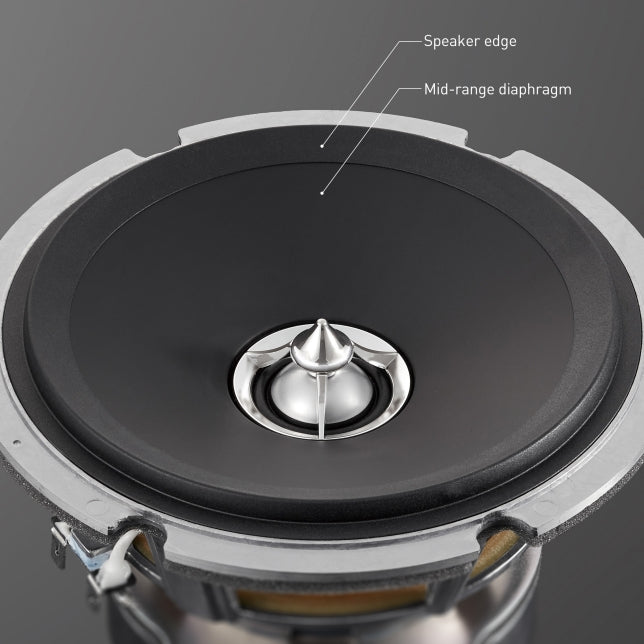
The originally shaped acoustic plug is positioned on the front side of the tweeter diaphragm and provides a high-resolution sound reproduction capability and a wide sound stage. The tip of the Linear Phase Plug is made from a high-modulus, high-density brass material. It prevents the plug from vibrating unnecessarily due to the effect of the vibration of the mid-range unit, thus delivering clear and low-distortion sound.
When sound wave propagates along an irregular surface, its wavefront becomes disturbed due to the surface irregularities and results in the degradation of frequency characteristics. This affects particularly the characteristics of high frequencies with short wavelengths.
The diaphragm of the mid-range unit, which is part of the coaxial speaker unit, has a shallow shape with a smooth edge to reduce sound reflections so that the disturbance to the sounds radiated from the diaphragm is minimized, resulting in excellent frequency response, phase characteristic and wide directivity.
This configuration achieves a wide sound stage and smooth and rich mid- to high-frequency range.
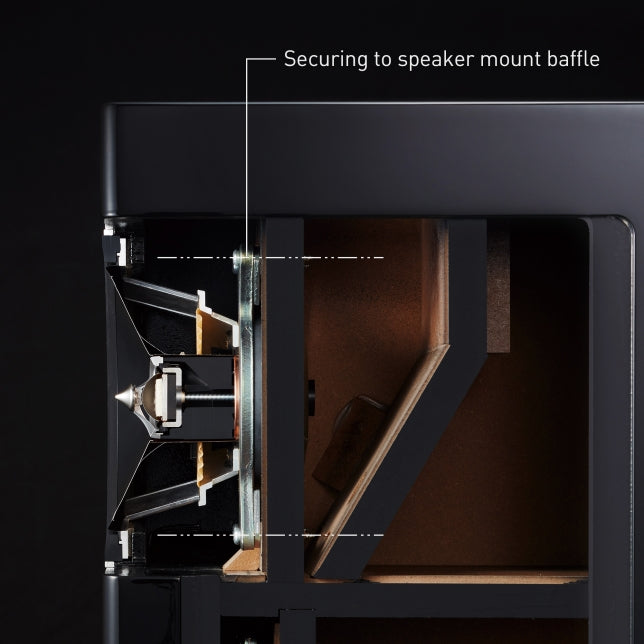
Balanced Driver Mounting Architecture
Unwanted vibrations generated by the speaker mount baffle have been further reduced by improving the vent holes using CAE and by allowing the one-piece woofer amount baffle to penetrate the bottom board for achieving higher rigidity. What’s more, the optimized vent holes improve the distribution of sound radiated from the back sides of speakers for enhanced response. In addition, the coaxial speaker mount baffle is separated from the woofer mount baffle to eliminate the mutual interference.
Together, they further enhance the crispness of sound and three dimensional presentation of sound field.
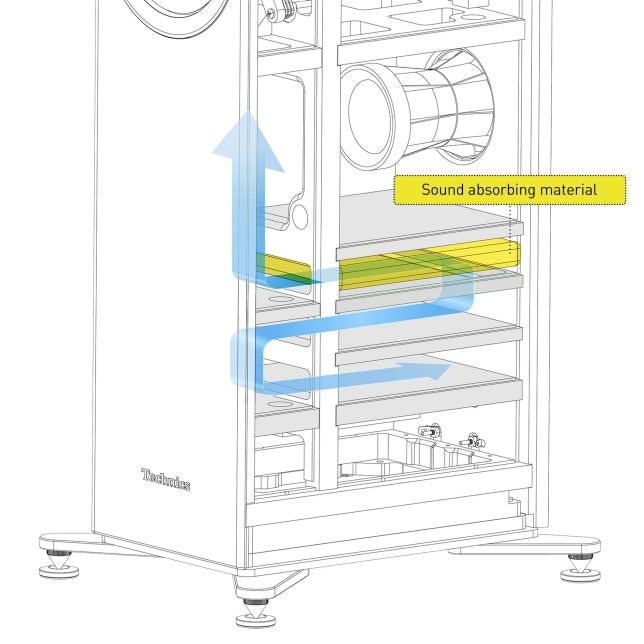
Standing Wave Termination Structure
A resonance called standing wave is usually generated inside the speaker cabinet by the sound of a certain frequency determined by the cabinet size. The most common method to eliminate the standing wave is to install a sound absorbing material inside the cabinet. However, since sound absorbing material also absorbs sound at frequencies other than the one that generates a standing wave, it somewhat removes dynamism or vividness from the reproduced sound.
As a countermeasure, a sound path structure is provided at the bottom of the woofer cabinet to guide the standing waves. Sound absorbing material is installed at the location in the sound path where the speed of sound becomes fastest. This enables the efficient removal of standing waves, which are the cause of resonance peaks, with a minimum amount of sound absorbing material.
This structure allows the use of all information necessary for accurately reproducing music so the speaker system realizes more vivid and natural medium- and low-frequency sound.
Specifications:
| Type |
3-way 4-speaker Bass Reflex (coaxial 2-way midrange / built-in tweeters) |
| Speaker Units (Woofer) |
16 cm (6½") Cone type × 2 |
| Speaker Units (Midrange / Tweeter) |
16 cm (6½") Cone type × 1 / 2.5 cm (1") Dome type × 1 |
| Impedance |
4Ω |
| Input Power (IEC) |
100 W (Rated), 200 W (Max) |
| Recommended Amp Power |
40 – 200 W (Speaker tested by IEC60268-5 Short Term Max Test) |
| Sound Pressure Level |
86 dB / 2.83 V (m), 83 dB / W (m) |
| Frequency Range |
33 Hz – 90 kHz (-10 dB) |
| Crossover Frequencies |
500 Hz, 3.4 kHz |
| Dimensions (W × H × D) |
11-1/2 × 43-27/32 × 14-2/5 inch (including spikes) |
| Weight (per unit) |
Approx. 78 lbs |
| Accessories |
Spike × 4, Spike shoe × 4, Spacer × 4, Base plate × 4, Base plate screw × 12, Rubber foot × 4, Short wires × 2, Speaker net × 1, Cleaning cloth × 1, Owner’s Manual × 1 |
 Speak to a HiFi Guide • 1-888-326-7490 • Mon-Fri • 8am to 5pm MST