 Speak to a HiFi Guide • 1-888-326-7490 • Mon-Fri • 8am to 5pm MDT

An Afternoon With Monos: Mark Levinson No. 536 Power Amplifiers
It can be exciting, and also just a little bit of a bummer whenever I see a product I write about in The Gearhead blog sail out the door immediately. Now, of course, I have to be excited that a product that really captured my fancy is going to be enjoyed for a long time by another audiophile, somewhere out there.
But for everyone else reading my words of praise for this funky tube amp or that rare pair of speakers, seeing it’s no longer available must be a little bit of a letdown. Which brings me to the raison d’etre of today’s post, the idea of which began when a bunch of huge amplifiers rolled through the door at the same time.
It’s not every day in The Music Room’s testing department that we see two pairs of the same mega amp come through for listing, but recently we had to put our muscles to work when we received four giant Mark Levinson boxes from two different previous owners. Inside each pair of boxes were the left and right channels of Levinson’s excellent No. 536 monoblock amplifier, and it occurred to me that this might be different.
Really, there’s a great chance that if you’re reading this weeks after the initial post, one of the pairs may still be available. The No. 536 from Mark Levinson is a statement design, and a foundational piece — the purchasing of which is the kind of major component decision that requires much consideration on the part of the audiophile. So I felt like this was a great chance to learn what ML is up to for my own curiosity and to offer some commentary that will help the subsequent owners make their decision. My back and arms were going to protest, but I signed up to do a little mini review, Gearhead style.
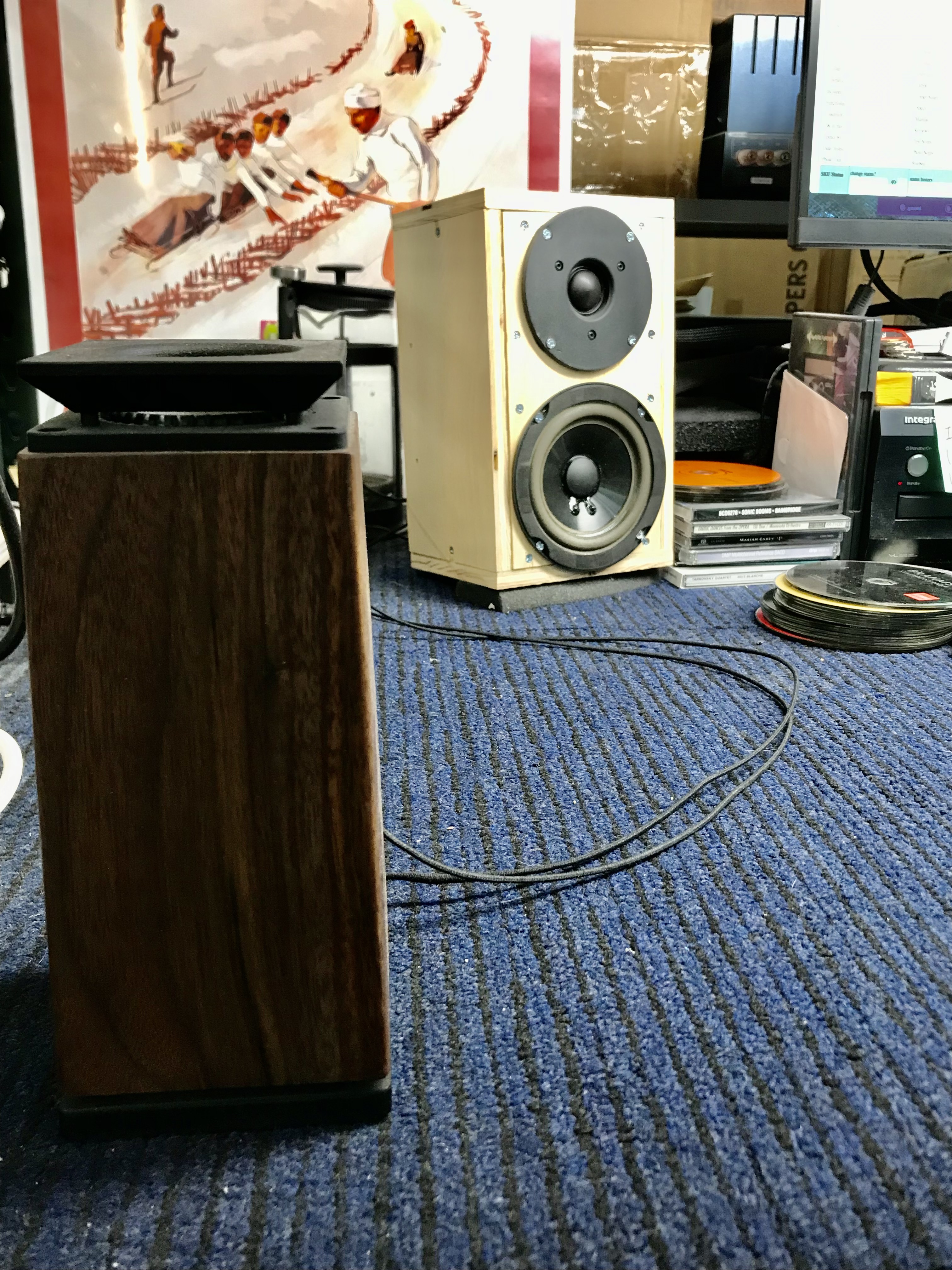 OK, that’s great, but one look at my desktop speakers here at TMR headquarters (right) made me realize I’d really have to take a pair home to review and write about them properly. My homemade mini monitors flanked by Decware’s curious little Tiny Radial desktop omnis are fun (and together they cast a soundstage like an IMAX movie). Still, they won’t help me answer the essential question for the audiophile considering a pair of Ultra-Fi, foundational mono amplifiers in a commensurately apportioned stereo system. Namely, “How does the No. 536 interact and mate with modern state-of-the-art or otherwise reference speakers?”
I don’t need to go further into describing the amplifier/speaker relationship than to acknowledge that I believe it is the heart and soul of system synergy in most HiFi systems around the world. To get a really good bead on how these beauties sound and where their strengths lie, I had to put them in my own listening room to mate with my 6-foot-tall, Dunlavy SC-III floorstanders.
My speakers have some years on them, but the tweeters have been replaced, and they’ve never been outside of the dry state of Colorado — they don’t know a thing about humidity. The crossovers look like they rolled off the factory floor yesterday. There are a couple of time capsules harkening back to an exciting time in HiFi audio, in the 1990s in America, when guys like Richard Vandersteen and John Dunlavy were extolling the virtues of time alignment and phase coherence in speaker design, and breaking new boundaries in that area.
My home system is simple on the outside, but fairly well-treated and tweaky when you look more closely. All tweaks, like the Shakti stone on the DAC, the Furutech outlet, the fuses, or the five Quiet Line ac filters, are there because they make a positive difference. The PS Audio Power Plant P10 perhaps works the hardest, and custom cabling with excellent connectors and Belden’s noteworthy Iconoclast XLR interconnects round out a system I’ve spent months dialing in.
It’s a great place to slot in the big Levinson amplifiers for two reasons: First, I’m used to tubes in this room — excellent tubes with power and bass extension. Second, I’ve never heard a set of mono amps in this environment, though I’ve always been curious. The amp I use normally is heavily modified and a serious contender in its own right. Still, the statement of solid-state design from Mark Levinson should contrast significantly with what I’m used to.
I wouldn’t say tube amps don’t make bass, but moving from tubes to a reference pair of solid-state monoblocks, as I’m preparing to do here, is going to involve a major bass change. I’m excited to hear it, but I’ll hit pause on the review for now to set up the system and get a couple of hours of playtime under its belt before I listen. Remember — one of the many benefits of buying used HiFi in great condition is that all the parts that tend to change in the initial burn-in after the factory are things of the past. It shouldn't take too much warm-up to start hearing the magic.
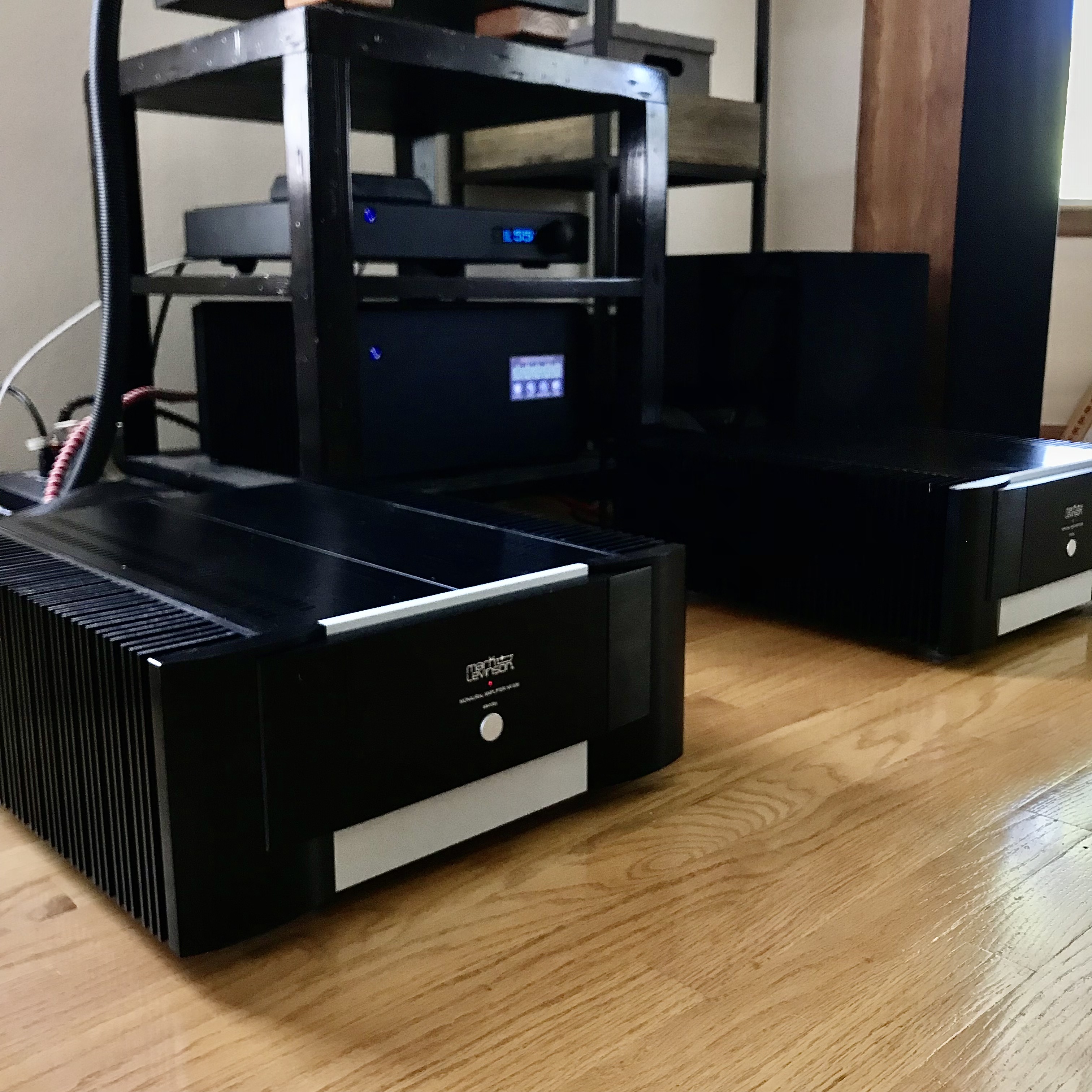
After they warmed up a bit, I could tell the Mark Levinson No. 536 amps I’d taken home to review were really starting to open up. Soundstage things were happening, tonality was fantastic, and the layers of detail were being added with every passing song. It was time to start listening seriously and jotting down some thoughts.
Spinning up
Tom Misch’s fascinating new release, Quarantine Sessions, is a fitting album to kick off the exploration into what a state-of-the-art pair of monoblocks can do to a previously tube-based, revealing system. There are some vocals, but it’s largely instrumental and at many times relatively untreated and raw.
The album is a collection of five cover tracks and three originals, recorded, as the name suggests, during last year’s quarantine. Which, I’m sure we’re all aware, was not very kind to musicians. But it does seem that, during that period, some had more time to compose and record with creative freedom and few expectations.
The No. 536 amplifiers show up large and in charge on the opening track, “Chain Reaction”. They roll out a thick red carpet of electric bass to kick things off, and the groove steps out of its limo in short order before walking along for a solid minute. At this time, the beauty of mono amps versus stereo is easy to hear. The strength of the solid-state damping factor is also easily heard. Wow.
Mono amps never allow the channels to rob from each other, power supply-wise. Not many “dual mono” type stereo designs offer two power transformers for proper separation. Nearly all the time, if you want to hear what your speakers sound like when truly powered individually, you’ll have to consider monoblocks, giving each speaker its own amplifier with its own power supply.
Let’s not forget that an amplifier is little more than a dressed-up, modified power supply. If you don’t think power quality and availability are a big deal in music playback, I have a book or two you might want to read.
The bass grunt on “Chain Reaction,” one of the few originals on Quarantine Sessions, is no mirage — it’s just physics. The ML No. 536 monos have the capacity to send nearly 800 watts to my 4 Ohm Dunlavy SC-III speakers (ok, I’d maybe need a bigger Power Plant for full output), and they’re making the thin, imaging specialists sound a little more like their big Dunlavy brethren.
Actually, a swift Googling of my reference speakers shows a range of opinions from “they are bass light” all the way to “terrible for bass”, and on and on. Ha! If you keep reading, you'll find that most of these opinion spouters power the SC-III sleepers with terrible electronics. Receivers from the ‘90s, cheap Class D amps, you name it.
If only some of them would be bold enough to try a modern $30,000 pair of regenerator-powered monoblocks on the nearly 30-year-old Dunlavy time-coherent speakers. Oh, well.
I'm kidding, obviously, and I realize I’m in a unique position to try things like this and write about it. The results are just incredible. Without my subwoofers on, the SC-IIIs DO have bass — great bass from a usually somewhat demure 7” driver. But all this talk about bass and current ability kind of overshadows the amplifiers’ natural holographic skills. Dunlavs (mine being of WMTMW design) are known to cast a wide, super-engaging sound portrait, and it seems that if there is ever an amplifier to help them do that right, it’s the No. 536 from Mark Levinson.
Hanging in space
It occurred to me that this reference pair of amplifiers has a job that can be considered more demanding than most other amplifiers. They’ve got to be truly resolving (i.e., clearly showing the differences between recordings, which can go as far as sounding like a different amp on every recording) on the world’s most demanding loads — and I don’t just mean ones with low impedance dips.
At this price range and audio technology level, the expectations are as demanding as the loads. The No. 536 amplifiers are typically paired with Wilsons, Vandersteens, Rockports, and other mega speakers. And these are likely a fine-tuned-by-dealer setup, perhaps even graced by matching REL subwoofers, which were also likely set up with expert help.
In systems like these, the stakes are incredibly high. The No. 536 monos are up to the task, and they really could not care less about the connected equipment, which is funny because extremely revealing speakers such as those I mentioned care very much about the quality of connected equipment and cabling. But you know, if speakers measured like electronics do (as some of Dunlavy’s designs were said to) everyone would get along a bit better in the system. Some gear is just touchier than other gear — what can you do.
Back to my system and the next album up, which features a duo of handpan drummers from Bristol, UK. I’m hearing subtle details in the soundstage that are new and thrilling, and I know these amps are cooking now. If you’re not familiar with the duo Hang Massive and their curiously shaped drums (also called “hang” drums), their incredible release from 2018 called Luminous Emptiness is a fitting introduction.
The recording’s got a wide, reverberant soundstage, and the rhythmic playing of the two drummers is often embellished or supported by surgical electronic effects. This makes the frequency balance extra wide and the dynamic range super large, and helps make the case for many of the album’s tunes to be added to my “demo tracks” playlist.
In the early tracks, like opener “End of Sky,” we enjoy a beautiful separation of the players across the soundstage, with the left-most player well left of the left speaker. I also noticed that after particularly vigorous individual hand strikes on the drums, a metallic shimmer is created alongside the tones, and the No. 536 amps showcase this easily and without fanfare. The amount of resolution is really on display when you hear these sometimes dissonant overtones hanging in space as clearly as a fundamental, without any kind of highlighting or “mastering assistance” from the amps. Every tone feels right, whether it’s from the main tone or from the harmonics, which is a beautiful thing to witness.
Wrapping up?
For being such strong brutes, they are an incredibly sensitive and observant pair. This is what high-bias Class A power can do for a pair of reference speakers. And on mine, which admittedly has as gentle an impedance curve as you’ll find in this category of speaker, the No. 536 monoblocks have hardly broken a sweat.
This being The Music Room, we of course have bigger or more expensive speakers in stock with much more brutal impedance curves to test the Mark Levinson 536 mono amps, but I needed to hear these magical music makers on an extensively dialed-in reference system. To adequately share the kind of power and grace possible in these words and pages, I needed them at their best.
And at their best, they are in rare company in the Ultra-Fi, high-class-A-biased power amp landscape. They’ve got the goods to dance with the cream of the speaker crop. I appreciate the amps’ honesty and lack of coloration compared to some of their market competition, which can tend to sweeten things against the occasionally ruthless nature of the reference level of modern speaker makers.
~~~
Alright. I want to try one last song here before I have to hoof these monsters back to the office. Perhaps that’s just a flimsy excuse for me to share this killer track with you, or maybe I’m delaying the inevitable, back-breaking work of moving them. Still, the young Polish guitar whiz Marcin and his treatment of Beethoven’s “Moonlight Sonata” needed to be played through the No. 536 amps’ circuitry.
Anyone following along and listening to the music I reference will get the deal about this prodigy’s mind (and speaker)-bending production style immediately. I wanted to hear three things: bass quantity/quality, image placement, and coherence through the chaotic moments. The No. 536 amps performed flawlessly, and as I cranked the volume, I was trying to get past the Class A portion of the A/B amps’ range.
No dice, we’re still in Class A boys, and let’s shut it down before we break something. That’s what I was expecting from a pair of legitimately “Ultra-Fi” amps: grace, honesty, and power under high pressure.
Wrapping up
For any serious audiophiles looking to anchor their system on a rock-solid foundation, the Mark Levinson No. 536 deserves as much attention as any power amplifier in this category. In the testing department of The Music Room, I’ve played with D’Agostinos, Soulutions, Boulders, and CH Precisions. The No. 536 amps may not be as flashy or feature-rich as some of those brands' amps, but they belong in this group as foundational system centerpieces in the modern HiFi era.
Articles and More Gear From Mark Levinson
For more on Mark Levinson Amplifiers, read:
Shopping for a used Mark Levinson amp? Browse models like the No. 532H, No. 585, and No. 536 that have passed through TMR’s consignment and trade-in program — all fully tested, certified, and ready for reference-level performance.